Pinion Gear question

White Lincoln

PostWhore
Birdcats Supporter
Joined
Oct 2, 2023
Messages
1,667
Location
New Mexico
  • Cars in Garage
    1
  • Vehicle Details
    1994 Mercury Cougar XR7, 3.8L, all stock
    Country flag
    Good day,
    I replaced the pinion seal on my Town Car recently, but when I took the car off the jacks and for a test drive, I get this clicking or clunking noise when in reverse. And the drive shaft sounds like it is out of balance, but this is at 5-6 mph. Driving forward does not have the same results. I put the car back up on jacks and checked the parking brake and it was not that. I ran the car in 1st gear on jacks to keep the speed down to 5mph and drive shaft is not turning that much. The clunking is coming from the u-joint / pinion gear area. I also pulled the U-Joints and inspected them and they were in good condition still. I thought I tightened the pinion nut correctly per the notch I made with the pinion gear shaft and the nut, but the more I read, it would seem I have it too tight, as the symptoms are similar to the nut being too tight. I even wondered if I got the diff pinion gears (spider gears) were off a gear, but that would be impossible because you can't put the cross pin in if they were off.

    I am going to take the car into Ford cause my back can't take another round of jacking and crawling, but wanted to know more or less what to tell them I think the issue is.

    If I did not tighten the pinion nut enough, would it cause the same issues? I didn't see anything about not tightening enough issues.
     
    On a pinion seal replacement - best practice is to do like you mentioned and mark a notch in the original nut position .. and when re-installing to go just a hair past the mark. Anything more may compromise the pinion depth setting.
     
    I think it’s more likely that you didn’t tighten it enough than that you over tightened it. Did you only replace the seal, or did you have the whole diff apart? If everything was apart, did you replace the crush sleeve? Did you measure the torque required to turn the pinion gear? If you left the carrier in place and only replaced the seal, then the mark method works pretty well, but I usually go just slightly past the mark to crush the sleeve just a tiny bit more to keep enough preload on the bearings.
     
    On a pinion seal replacement - best practice is to do like you mentioned and mark a notch in the original nut position .. and when re-installing to go just a hair past the mark. Anything more may compromise the pinion depth setting.
    Exactly. I did do that as well, about 1/8" past the mark I made.
     
    I think it’s more likely that you didn’t tighten it enough than that you over tightened it. Did you only replace the seal, or did you have the whole diff apart? If everything was apart, did you replace the crush sleeve? Did you measure the torque required to turn the pinion gear? If you left the carrier in place and only replaced the seal, then the mark method works pretty well, but I usually go just slightly past the mark to crush the sleeve just a tiny bit more to keep enough preload on the bearings.
    Yes, I only replaced the seal. It was leaking from age and it needed to be replaced.

    As for doing the torque thingy, I was trying to figure out how to set my micrometer torque wrench to test the strength and realized you need a Drive Beam Torque Wrench, which I do not have. So I said F-it and went hell bent into the project.

    Anyone know what the torque might be for a 95 Town Car differential pinion gear? (that was a joke...)

    Just the same, in my mind, I did not tighten it enough. I read somewhere, and maybe it was not related to this, that the torque is about 185 ft/lbs for the nut. I don't think so, but the point being I don't think I tightened it enough.

    After saying F-it with the Town Car, I put the Cougar up on ramps yesterday evening, replaced the starter and replaced a broken fog light and by then, I plum had enough of crawling under the damn cars to last several months. Time to just take the car into a shop close to home, hope they don't screw me on the price and just fix the pinion nut.
     
    There isn’t a torque spec for the pinion nut, there is a spec for the torque required to turn the pinion when everything is tightened, which is 8-14in-lbs. However if you only replaced the seal, you can’t check that because you would have to remove the axles and carrier to get an accurate reading, hence the method of making a mark in both the gear and the nut, and going slightly past that. If you did that, it is possible you are a full turn too loose. Either that, or you are a full turn too tight. Either way, I would get under there and try to tighten it some more before bringing it somewhere. If it is too loose now, it’s and easy fix to just tighten it up, and if it is already too tight, then it all has to come apart to replace the crush sleeve anyway, so you really can’t make it any worse by trying.
     
    I usually mark the location rotationally, measure the amount of thread sticking out of the pinion nut with a pair of calipers, and count the turns. Last time I did the pinion seal on the Crown Vic I thought for sure that I had counted the turns on and back off correctly, but a quick check on how much thread was sticking out of the nut confirmed I was still one turn out.
     
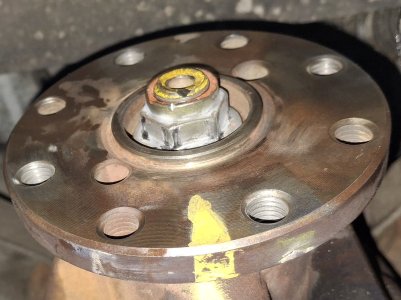
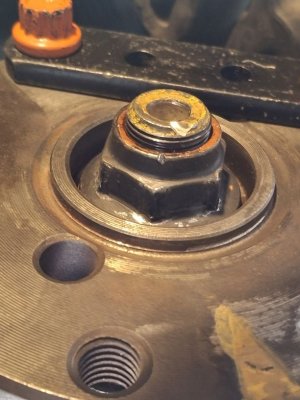
    From this pic, it looks (to me) as though I need another thread as I recall before I took the nut off. And yes, I replaced the pinion seal AFTER doing the axle bearings and seals. I have never replaced pinion or tranny seals before and I can keep kicking myself in the head for NOT taking a pic before removing the nut. I looked through all my pics and not one of the pinion nut. You can see the marks I made on the shaft and the nut. I tightened it just past the shaft mark.

    One thing I forgot to ask is, can I drive this to a garage with the nut being too tight / too lose? It's like 2 miles to the nearest shop. As mentioned, I would like to just do this myself, but my back is getting worse. I still might put it up on ramps and see what do. Thanks everyone.

    Pinion nut 3.jpg
     
    If it’s too tight, it could damage the bearing, and if it’s too loose, it could damage the gear. The bearing is cheap, but a new ring and pinion, plus the extra labor to set them up properly is not. That’s why I would definitely try to tighten it another turn before anything.
     
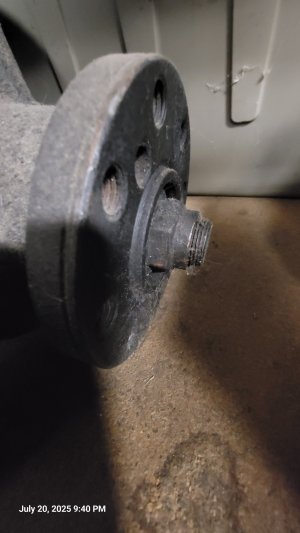
    1000011506.jpg

    Here is a factory installed pinion nut for comparison . Tolerance for shim is usually pretty consistent so well assume this to be close to a normal depth.
     
    Excellent. I think I will give this another go this weekend if not sooner. But dang, crawling under this car is getting old fast.

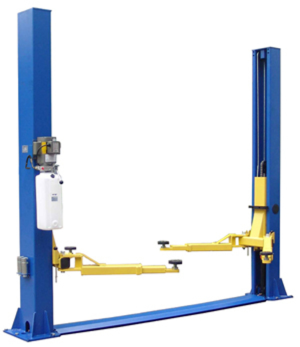
    I need to talk the wife into letting me get one of these:

    1753111642504.png

    So, aside from all of this, would it be wise to put the car up on jacks, crawl under, remove the drive shaft (not drop it, just remove the rear end), tighten the nut a turn, put the drive shaft back on, test the drive shaft by running the car in reverse, forward, etc and repeat until it runs smooth?
     
    I found this video (
    ) that was a lot of help in understanding more about how tight that nut has to be and how to measure the pre-load. This is on the 8.8 rear end, which is what both the Cougar and Town Car have. And yes, I did not tighten that nut near what it needs to be in recalling how I tightened it.

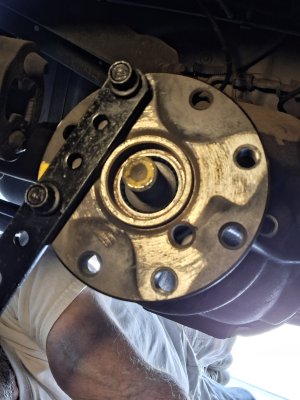
    I made a companion tool from a garage door curved door arm. I only had to make the holes a little bigger with my drill press.

    companion tool.jpg

    Thanks all of you that chimed in for the encouragement in trying this on my own instead of taking it somewhere. I am always afraid a shop is going to pull the BS that "the pinion gear was damaged and we have to replace everything" lie so they can screw me on the price.

    I will follow up in a week or so on how this went.
     
    I remember custom spark plug wrenches for getting the rear plugs on a chevy monza with a v8; there's a lot of the 70's I don't miss. :)
     
    I remember custom spark plug wrenches for getting the rear plugs on a chevy monza with a v8; there's a lot of the 70's I don't miss. :)
    Mustang 2 with a 302 and having to lift the engine to change the plugs....
     
    Well, you guys did it to me now... I decided to just take a bunch of pain meds, jack the F'in car up on both ends, crawl under, hook up my home made companion tool and wiggle the pinion. Holy Diver! (whatever that means in relation to this) the dang thing is LOOSE! I took out the drive shaft, mounted the companion tool and got my torque wrench out, set it to 100 ft/lbs for starters and started turning. I have much more to do and it was late into the night last night so I said I would pick up the rest tomorrow. More to come.
     
    There’s usually between 3/16-1/4” of the pinion threads sticking out past the nut so I can definitely tell just visually it’s not tight enough. Right now you’re probably still fighting pressing on the companion flange on the splines.

    I much prefer crush sleeve eliminators that replace the crush sleeve entirely. It’s not the right way to do it but you could simply use the stock crush sleeve and calipers to measure it to get the thickness you need without having to go through pulling the axles et al and take a rotational torque reading, then just put it all together and torque to like 150-200 ftlbs. It’s all accessible without pulling the ring and pinion, it installs from the seal side and unlike the inner pinion bearing the seal side one just slides right out giving access to the crush sleeve.

    To actually crush the the crush sleeve you need such a stupid amount of leverage you’ll never get lying on your back with the limited space of jackstands, it’s a lift job
     
    There’s usually between 3/16-1/4” of the pinion threads sticking out past the nut so I can definitely tell just visually it’s not tight enough. Right now you’re probably still fighting pressing on the companion flange on the splines.

    I much prefer crush sleeve eliminators that replace the crush sleeve entirely. It’s not the right way to do it but you could simply use the stock crush sleeve and calipers to measure it to get the thickness you need without having to go through pulling the axles et al and take a rotational torque reading, then just put it all together and torque to like 150-200 ftlbs. It’s all accessible without pulling the ring and pinion, it installs from the seal side and unlike the inner pinion bearing the seal side one just slides right out giving access to the crush sleeve.

    To actually crush the the crush sleeve you need such a stupid amount of leverage you’ll never get lying on your back with the limited space of jackstands, it’s a lift job
    I hope other people read these threads, because they have such a good amount of information in them. Thanks for the info an eliminator for the crush sleave.

    Well, I turned the SOB pinion nut 2 more times, just past the original shaft mark, put the drive shaft back on and fired up the car. Ran it through reverse and forward, let it run in reverse for a bit and in 1st gear and no more clunking or weird noises. Do I have it far enough? I don't know without an orginal pic. But yes, that last turn was brutal.

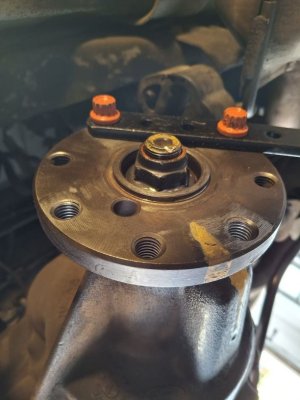
    here are some pics:
    Pinion nug mark.jpg

    Pinion w companion.jpg

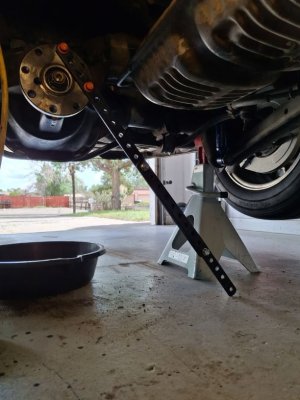
    Companion bar with extension.jpg

    Yep, that companion bar I made has an ADJUSTABLE EXTENSION!!! LOL

    I'm gonna let it sit overnight and see if have any leaks from the pinion seal. Then take it down, drive it around and see I notice if it needs to be tighter.

    (and get some more gear oil as I lost a bit with it sitting and leaking from the pinion nut not being tight enough)
     
    One thing the guy did in the video was put a inch / lb torque wrench on the pinion and said he wanted it to be between 16-22 in/lbs. I need to check that as well. It's nothing to drop the drive shaft other than it is a bit bulky. Glad the exhaust holds it up when you pull it off the axle.

    Dang, my torque wrench starts at 20 in/lbs... shew!
     
    Last edited:
    That 16-22in-lb reading is with the axles and the carrier removed. That is the torque for just turning the pinion gear. That’s why we use the marking the nut method, because doing it the “right” way involves taking apart the entire diff. So for just replacing a seal when the gears and bearings are not in question, the mark the nut method gets it close enough.
     
    Thanks for saving me some time dDUBb and Mikey.... and yes, I do recall the guy in the video did have just the pinion in, no axles.

    (i'm glad someone knows what they are doing on this site...)
     
    Question: Book says torque on pinion nut is 160 ft/lbs. What conditions would that be under or is that ideal with only the pinion installed and no spider gears / axles, etc. I had my torque wrench at 100 ft/lbs and never got the "click" and have to wonder if I need to try another round or not.
     
    Without pulling the whole thing apart and replacing the crush sleeve, all torque specs are out the window. The only thing you have to go on is your marks that you made. If it is just past the mark and doesn’t have any play, then you’re good. If it still has play, then you need another turn. But if you over tighten it, then the crush sleeve will be crushed too far, and there will be too much preload on the pinion bearing, which will kill the bearing, and you can’t just back it off because the crush sleeve won’t re-expand to take up the slack.
     
    Without pulling the whole thing apart and replacing the crush sleeve, all torque specs are out the window. The only thing you have to go on is your marks that you made. If it is just past the mark and doesn’t have any play, then you’re good. If it still has play, then you need another turn. But if you over tighten it, then the crush sleeve will be crushed too far, and there will be too much preload on the pinion bearing, which will kill the bearing, and you can’t just back it off because the crush sleeve won’t re-expand to take up the slack.
    One thing I got out of that video I found that was so helpful is testing the play in the pinion using the companion tool. that is how I knew I had tightened it enough when I had no more play. I would tighten, check the mark locations, check for play, then tighten some more until the mark was just past the shaft mark and there was no play. Now, as for the slack in the drive shaft seems about the same, but sounds more like its coming from the tranny when I rock the drive shaft back and forth. I will update once I get it off the jacks an on the road how well it drives. The pre-test by going through the gears on jacks seemed to prove promising. thanks Mikey.
     
    Question: Do you guys just put your finger down the diff fill hole to see that the level is? About a finger nail length before the top of the fill hole? The book says 0.25 - 0.56 inches (1/4 - 1/2") from fill hole hole is where the level is.
     

    Similar threads

    Back
    Top