The Terminator was a mix of the stories of Fred Saberhagen, and his beserker series. The cone shaped planet destroyer in OG trek was a beserker. They were life exterminating robotic killers. Destroying Planets and stars were were just collateral damage. They even killed the bacteria, lol.

en.wikipedia.org
For a more humorous but still chilling, throws murphy's law into the mix: "Code of the lifemaker" by James P hogan. He also does a book on ai: The Proteus operation. The religious folk would go nuts If they released a movie of either. the opening scene of Of Proteus is an illustration of what can go wrong:
PROLOGUE
The planetismal began as a region of above-average
density that occurred by chance in a swirling cloud of
dust and gas condensing out of the expanding vastness
of space. Gently at first but at a rate that grew steadily
faster as time went by, it continued to sweep up the
smaller accretions in its vicinity until it had grown to a
rough spheriod of compressed dust and rock measuring
fifty feet across
Eventually the planetismal itself came under the pull
of a larger body that had been growing in similar fash-
ion, and began falling toward it. It impacted at a speed
of over ten miles per second, releasing the energy
equivalent of a one-hundred-kiloton bomb and blasting
a crater more than half a mile in diameter.
Shortly afterward, as measured on a cosmic time-
scale, a second planetismal fell close by and created an-
other crater of similar dimensions; the distance
between the crater centers was such that the raised
rims of debris thrown up by the explosions merged to-
gether for a distance, resulting in the formation of a
ridge of exaggerated height between the two basins.
In the time that followed, the rain of meteorites con-
tinued, pulverizing the landscape into a wilderness of
sharp-grained dust to a depth of several feet, the deso-
lation being relieved only by the occasional outcrop or
shattered boulder. The outlines of the craters were
slowly eroded away and stirred back into the sea of
dust.
When the bombardment at last petered away, all
that remained of the ridge was a rounded hummock to
mark where the rims had intersected—a mound of dust
and rock debris forty feet high and several hundred
2 The Two Faces of Tomorrow
long. There it remained as one of the weary but tri-
umphant survivors that were left to stare out over the
gently rolling wastes that stretched to the horizon.
From then on the ridge remained essentially un-
changed. A steady drizzle of micrometeorites continued
to erode the top millimeter or so of its surface, exposing
fresh material to trap hydrogen and helium nuclei from
the solar wind; particles from sporadic solar flares
caused isolated nuclear transformations down to
several centimeters, and cosmic rays penetrated slightly
farther. But in terms of its size, shape and general ap-
pearance, the ridge had become a permanent feature
on a changeless world.
Four billion years later, give or take a few, Com-
mander Jerry Fields, assigned to the International
Space Administration's lunar base at Reinhold, was'
standing staring up at that same ridge. Beside him,
similarly clad in a blue-gray spacesuit bearing the
golden-flashed ISA shoulder insignia, Kal Paskoe
frowned through his visor, studying the line of the
ridge with an engineer's practiced eye. (
"Well, what do you think?" Fields inquired into his
radio. "See any problems?"
"Uh uh." Paskoe's reply was slow and noncommittal
as he squinted against the glare of the setting sun. He
turned to stare back at the metallic glint that marked
the position of the base at the foot of the low hills on
the skyline behind them, then returned his gaze to the
ridge to register mentally a couple of salient boulders
near its crest. "No ... no problems," he said at last.
"I think I've seen all I need. Let's get back to the truck
and get the job scheduled. We can't do any more here
until the computers have figured out how they're going
to handle it."
The mass-driver at Maskelyne, over a thousand
miles away on the western edge of Tran quill atis, had
been in operation for almost a decade. It had been
built as part of the EXPLORER (Exploitation of
Lunar ORE Reserves) Project to hurl lunar rock up
into orbit for metal extraction and construction of the
huge space colonies being assembled within several
hundred thousand miles of Earth. In fact the tide was
Prologue 3
something of a deliberate misnomer. There were of
course no true ores on the Moon—ores in the sense of
metal-rich substances concentrated by weathering and
geological processes. Deep below the surface, however,
were rich accumulations of titanium, aluminum, iron
and suchlike that had been precipitated by thermo-
fluidic processes operative during the Moon's early his-
tory. The compounds bearing these elements had been
dubbed "ores" by the media and the name had stuck
The mass-driver was a five-mile-Iong, ruler-straight
track flanked by two "hedges" of continuous electro-
magnetic windings—an immense linear accelerator
stretching westward across Tranquillatis. It accelerated
supercooled magnetic "buckets" riding on cushions of
flux at lOOg to reach escape velocity in the first two
miles. Beyond that the buckets were laser-tracked and
computer-adjusted to eject their loads of moonrock in
a shallow climb that just cleared the mountains two
hundred miles away by virtue of the Moon's surface
curvature. En route the loads were electrically charged
by being sprayed with electrons and fine-trimmed by
massive electrostatic deflectors located at the two-
hundred-mile downrange point to leave the final phase
of launch with an accuracy better than one part in a
million—comparable to a football being kicked be-
tween the uprights from 3,000 miles.
From there on each load, comprising 60 pounds of
"ore," climbed steadily for two days until, 40,000 miles
above the lunar surface, it fell into a "Hippo" catcher-
ship stationed at the gravitationally stable L2 point.
The energy needed to power the mass-driver was
beamed down as microwaves from a three-mile-wide
orbiting solar collector.
Day in, day out, round the clock, the mass-driver
sent up a charge every two seconds, halting only for
maintenance or for occasional repairs. Every year, one
million tons of moonrock fell into the waiting relays of
Hippos. And farther out in space, the colonies steadily
took shape.
The project had been so successful that the powers-
that-be had decided to go ahead with the construction
4 The Two Faces of Tomorrow
of a second mass-driver. This one would also be lo-
cated on the equator, but near Reinhold, aiming out
across Procellarum. The track, the experts had
decreed, would pass right over the point at which
Fields and Paskoe were standing. Not a little to the
right nor a little to the left, they had pronounced after
extensive surveys, but right there-
First-phase preparation would require accurate
sighting with lasers, covering a stretch of terrain that
extended from a mile or more behind them to several
times that distance ahead, which would require an
unobstructed path. The ridge was not really large—
about the size of a dozen average houses set end to
end—but... it was in the way.
And so it came about that the form that had stood
valiantly to preserve its record of events from the ear-'
liest epoch of the Solar System at last found itself op-
posing the restless, thrusting outward urge of Man.
The ridge would have to go.
"How goes it?" The voice of Sergeant Tim Cum-
mings came through over the open channel from the
nearest of the two surface-crawlers parked a few
hundred feet back at the bottom of the shallow slope
that led up to the ridge.
"I think we're about-done here," Paskoe replied
"Get some coffee on, Tim. We're coming back down."
"See all you wanted from the top?" Cummings in-
quired.
"Yeah. Ifs pretty much as we thought," Paskoe told
him. "More or less symmetic on both sides. Probably
not more than fifty, maybe sixty feet thicit at the base."
He glanced automatically at the twin lines of footprints
that let up to the point on the ridge crest that he and
Fields had climbed to, and then led back to where they
were now standing.
"Let's go," Fields said, and with that turned and be-
gan heading back to the crawler. Paskoe gave the ridge
one final glance, then turned to follow at a slow easy-
going lope that brought him alongside Fields in a few
seconds.
"What do you reckon?" Fields asked as they
Prologue 5
bounced side by side down the slope. "Soil blower
maybe?"
"Dunno," Paskoe replied. "There are some big boul-
ders in there, and it's probably pretty well compacted
lower down. Might take a digger or two, probably a
heavy shover too. We'll see what the computers
reckon."
"There's some heavy equipment the other side of
Reinhold," Fields remarked. "If they shifted some of
that over here they might get started inside a day or
two."
"Nah—I'm pretty sure most of that stuff's tied up,"
Paskoe said. "They may have to fly something in from
Tycho. Anyhow, that's their problem. They know their
schedules. We'll just have to wait and see what they
come up with."
"As long as we don't end up having to shovel it,"
Fields said as they slowed down to approach the
crawler. Paskoe steadied himself on the handrail and
stooped slightly to clear his helmet past the entrance to
the crawler's lower cabin.
"No way," he declared with feeling. "I've seen
enough Massachusetts winters not to ever wanna see a
shovel again. I'll leave it to the computers. If they say
the best they can manage is a week, that's okay by
me."
"The boss'd get pretty mad about that if it hap-
pened," Fields murmured as he ducked to follow the
now invisible Paskoe.
"Then the boss could come out here and damn well
shovel it himself," Paskoe's voice said in his helmet.
Five minutes later they had removed their helmets
and were seated back at the crew stations beneath the
viewdome of the crawler's upper cabin.
While Fields and Cummings used the viscreen to dis-
cuss the next item on the day's agenda with Michel
Chauverier, who was in command of the other crawler
parked next to them, Paskoe activated the main con-
sole at the far end of the cabin to dose a channel via
comsat to the Tycho node of the ubiquitous TITAN
computer complex. After a brief dialogue via touchpad
6 The Two Faces of Tomorrow
and display screen, he had communicated the nature of
his request to the system's Executive Command Inter-
preter. A few seconds later the screen returned the
message:
ASSIGNED JOB NUMBER 2736/B. 11/7.11
SCHEDULED TO SUBSYSTEM: SURFACE ENGINEERING •
P.927
REQUIRE DATA REGARDING NATURE AND LOCATION OF
OBSTRUCTION
Paskoe remote-steered one of the crawler's external
TV cameras until he had an image of the ridge outside
nicely centered on one of the console's auxiliary
screens. Then he operated the touchpad again to bring
up two flashing cursors superimposed on the image,
and moved them across the screen until they lined up
with the boulder formations he had memorized. In this
position the cursors defined the portion of the ridge
that mattered.
He then tapped out a brief code with his fingertips.
In the fraction of a second that followed, the coordi-
nates of the crawler's identification beacon were read
and plotted by one of the invisible satellites high above.
At the same time the picture being picked up by the
TV camera was analyzed by the onboard computers
and the data extracted were used to align the laser
mounted on the roof with the centerpoint between the
cursors. The range, bearing and elevation data read
from the laser were instantly flashed to the Tycho com-
puters. From the readings obtained from the satellite,
the computers knew the exact location of the crawler
upon the lunar surface. The laser data enabled them to
compute the position of the ridge relative to the
crawler, and hence to deduce its precise coordinates as
well.
A few more seconds elapsed while programs at
Tycho pondered over the patterns contained in the TV
picture being sent to them. Then the words on the
screen vanished to be replaced by:
PROFILE?
Prologue
Paskoe responded:
BASE THICKNESS 60FT MAX.
OBSTRUCTION APPROX LONGITUDINALLY SYMMETRIC
COMPACTED REGOLITH INC OBSERVED DEBRIS TO
10FT DIA EST.
REQUIRED REMOVAL TO DEPTH EST 40FT. LEVEL.
He drummed his fingers on the console with growing
impatience while the machines meditated. No doubt
they were bringing in the crawler's armory of X-ray
analyzers, infrared analyzers and heavens alone knew
what else to scan the ridge and estimate its mass, com-
position, structural features and whatever else they
thought they needed to know to figure out how to go
about doing a perfectly simple job.
It was quite straightforward, he told himself. All
they had to do was decide which types of earth-moving
machine would be best suited—surely any dirt-farmer
could have told them that—check where they were lo-
cated and when they would become available, and ad-
vise how long it would take to get them moved here.
Then he'd be able to plan the next part of the job.
Computers! The simpler the task, the more it
seemed they had to fuss around with irrelevant detail.
Just like people.
PRIORITY REQUESTED?
Paskoe sighed;
ABSOLUTE BEST POSSIBLE
GRADE PB PROJECT BEING DELAYED REF. 2053/A.
THIS ITEM CRITICAL.
The computers, however, were not through yet
ANY CONSTRAINTS?
NO. JUST GET RID OF IT.
Another wait ensued. Then the words changed
8 The Two Faces of Tomorrow
again. Paskoe read them casually, blinked, sat forward
and read them again.
JOB SCHEDULED PRIORITY CATEGORY 'A-l'.
NO FURTHER QUERIES
ESTIMATED COMPLETION TIME IS 21 MINUTES.
Paskoe frowned and asked for a repeat . . . and got
it. Looking bemused, he turned and interrupted the
conversation still going on behind him between his two
companions and Chauverier.
"Hey. Look at this. Either I'm crazy or the system's
screwed up. Tell me I'm not crazy." Fields and Cum-
mings turned in their seats.
"What's up?" Fields inquired. Paskoe gestured
toward his console.
"Tycho's sized up the Job and it's giving an ECT of
twenty-one minutes."
"You're crazy," Fields declared without hesitation.
"Look at the screen."
"It's crazy," Fields decided.
Cummings rose from his seat and clambered across
the cabin to peer more closely at the display.
"What's going on?" Chauverier demanded from the
viscreen.
"Kal's got some screwy numbers back from Tycho,"
Fields told him. "Tim's gone to have a look."
"Could be a fluke," Cummings was saying, rubbing
his chin dubiously. "Maybe it's our lucky day. There's
probably a transporter due over this way that's carry-
ing just the stuff we need on a low-priority job some-
place. Maybe Tycho's rescheduled it to land here."
Paskoe pursed his lips and nodded slowly.
"Could be . . ." he agreed, then went on suddenly
more decisively. "Yep. You could be right, Tim. I
never thought of that. What do you think. Jerry?"
"Makes sense," Fields agreed. "We'd better stay put
to see what shows up." He turned back toward Chau-
verier, who was still peering out of the viscreen. "We
think there'll be a ship coming down here pretty soon,
Michel. There'll probably only be robodiggers or some-
Prologue Q
thing on it, but maybe we ought to hang around to
check it out. It should only be for a half-hour or so."
"Suits us," Chauverier answered readily. "In fact me
and Joe were just starting to get hungry. If we're going
to stick around here for a while I guess we'll eat. Do
you guys want to come on over for a bite?" Fields
turned back to the others.
-"Michel's inviting us over for lunch in his truck.
Okay by you two?"
"Great idea."
"Sure."
"Okay, Michel,"' Fields advised. "We're on our way.
Set it up for three more," With that he cut off the
screen. At the same time Paskoe killed the channel to
Tycho.
For the next few minutes they donned helmets and
took turns going through the routine drill of plugging
the test leads from their suits into the socket provided
in the panel by the floor hatch. Fields drew a "NO GO"
in the test. The codes being displayed on the panel's
miniature screen revealed an intermittent sticking valve
in his life-support- Muttering beneath his breath,
Paskoe began replacing the faulty valve in Fields's
backpack while Cummings called Chauverier again to
advise of the delay. Fifteen minutes later they were
ready to go.
"It won't last," Fields said over the radio as he
turned to begin following Cummings down the short
ladder below the floor hatch. 'Til bet fifty bucks on it.
Paggett is only there until he retires Earthside and until
then he'll just go on rubber-stamping. When he goes,
Cawther's bound to take over. Then it'll all be differ-
ent. I give it twelve months at the most," Cummings
had passed through the exit to the surface. As Fields
turned to follow, Paskoe began the descent from the
upper cabin, pausing halfway to secure and check the
hatch above his head.
"Anyhow, I'm not interested,", he declared, nodding
to himself and stepping down. "I'm only here for an-
other four. Then it's back home for me. A year's
banked back pay and a few months around Europe
10 The Two Faces of Tomorrow
with Cher. Wowie! You can take care of Cawther.
Have fun. I sure will."
"Europe?" Cummings, who was waiting for them
outside, came in on the circuit. "That's where you're
going?"
"All over," Paskoe said. "We never did get to see
more than a few of the tourist traps. This time we'll do
it right. Three months at least, Cher's especially keen
on Germany." They were crossing the gap of about
thirty feet that separated the crawler from Chau-
verier's. Paskoe and Cummings were side by side, with
Fields following a short distance behind.
"I was in Germany a couple years back," Fields's
voice came through. "Saw some of Poland too. There's
a place there you ought to see if you get the chance
... down south, Krakow I think it was called."
"What's there?" Paskoe asked.
"Salt mines. They go right back to the Middle Ages.
Man, are they big."
"Salt mines?" Cummings sounded mystified as he
and Paskoe came abreast of the other crawler and
moved around it toward where the entrance was lo-
cated. "What's so special about salt mines? I thought
they were places the Russians used to send people they
didn't like."
"Those are different," Fields replied. "There's a
whole cathedral down there way underground. All
carved out of solid salt crystal. Everything's salt—the
altar, the chapels, the statues, even the lights. It's fan-
tastic. And they've got—"
The universe blanked out.
"What in Christ! ..." a voice yelled.
Cummings had just reached the door with Paskoe
close behind. Fields was a few feet away, just beyond
the end of the vehicle.
Everything around them vanished abruptly into an
opaque sheet of gray. At the same moment Paskoe felt
the ground shudder beneath his feet. The mass of the
crawler above them lurched visibly as if it had been
struck an immense blow on the opposite side. For a
moment he had the sickening feeling that it was going
to topple over on top of them.
Prologue 11
A titanic blast of dust, debris and boulders had
smashed into the far side of the vehicle and sprayed
past it on every side. Mercifully they had been in its lee
shadow. Just a few seconds earlier and they would
have been caught unprotected. And just as suddenly it
was gone.
Paskoe was standing frozen to the spot, still with no
idea of what had happened. In front of him Cummings
was clinging to the handrail by the door, his face ashen
through his visor and his arm gesturing weakly toward
a point behind Paskoe's shoulder.
"Jerry! . . ." Cumming's voice came through in a
strangled gasp. "Jerry's gone!" Paskoe turned and
stared dazedly at the spot where, a few seconds previ-
ously, Fields had been standing, just beyond the
crawler's protective shadow. There was nobody there.
And then the blast came again, like the discharge of
a gigantic shotgun that fired moonrock. And again, and
again, and again . . . and again. Paskoe found himself
on the ground pressing himself against the vehicle's
tracks while the concussions thudded through his body,
and the crawler trembled under the repeated impacts
of boulders cannoning off its sides and spinning crazily
away into the maelstrom of dust. His helmet touched
the structure. A sound like a building collapsing onto
an enormous kettledrum exploded in his ears. He lost
count of the concussions. Maybe ten, twenty . . . His
brain had seized up.
He was lying by the track of the crawler, his heart
pounding and his body shaking. Every inch of his skin
felt cold and wet in his suit. It had stopped. He waited,
barely daring to breathe. The tension that held him
keyed up waiting for it to begin again refused to let go.
But nothing happened. He opened his eyes slowly and
looked up.
Cummings was lying on his back with his legs
tangled in the steps that bridged the gap between the
ground and the floor of the entrance hatch. He looked
as if he had been bowled backward out of the doorway
just as he had been in the act of climbing in. Still shak-
ing, Paskoe struggled to his feet, rivulets of sticky
moondust pouring down the creases in his suit.
12 The Two Faces of Tomorrow
"Tim . . . Tim can you hear me?" He lurched over
to where Cummings lay motionless, then stopped. A
slab of ice-cold horror dropped in his stomach as he
saw the shattered visor. And then a feeble voice
groaned in his helmet.
"Holy Christ, what happened?"
"Tim? . . ." Paskoe's voice was almost sobbing with
relief. "Tim, are you okay in there?" The sprawled fig-
ure moved, and gingerly extracted a leg from the steps
above it.
"I can't see," Cummings's voice came again, now
sounding less disoriented. "Something hit me in the
face." The other leg freed itself. Paskoe stooped and
helped Cummings to sit up. "Argh! . . . My chest! I
think I got hit by a shuttle booster."
"Can you stand up? Easy now. I gotcha."
"Take it slowly." Cummings's words came between
heavy breaths. "I think I might have collected a
cracked rib."
Paskoe hoisted Cummings to his feet and guided his
hand to the rail by the door. The chest panel of Cum-
mings's suit was smashed and the visor an opaque mess
of fractured crystal. Paskoe moved around to get at the
manual auxiliary controls on the backpack, which ap-
peared none the worse for having taken the impact of
Cummings's fall.
"You're visor's cracked but i( looks like ifs hold-
ing," he said. "I'm dropping the pressure in your suit
to relieve the stress on it. As far as I can tell you'll be
okay for a while, but we ought to get you into another
one ASAP."
"What happened?" Cummings asked again.
• "I don't know. If there was a war on I'd have said
we Just had a near miss from a salvo of 108's. Maybe
it was a meteorite swarm. I don't know.*' While he was
speaking, Paskoe was peering into the'lower cabin of
the crawler. The floor was covered in dust and some
larger debris. Shafts of light poured through several
jagged holes that had been torn in the far wall. Pre-
sumably whatever had made the holes had carried right
through and caught Cummings head-on just as he was
entering from the opposite direction.
Prologue 13
"What . . . What about Jerry?" Cummings asked
haltingly.
"He got caught in the open." Paskoe turned from
the door and began scanning their immediate vicinity.
"I guess he must have got blown away. Bad news I
. . . Just a sec. I think I see him." He could just make
out the twisted figure of Fields, crumpled in a mound
of dust that had appeared at the foot of a rounded
boulder twenty or thirty feet away. The layer of gray
powder covering it was so thick that Paskoe had at first
dismissed it as an irregular grouping of rocks. Cum-
mings remained silent, still clinging to the handrail
while he regained his breath.
This may be a bit much for ya'll, if so I apologize, please skip it.



 www.twz.com
 arstechnica.com
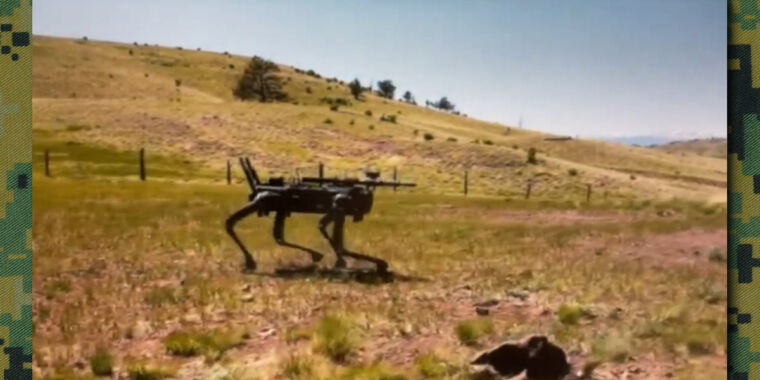
While I'm all for protecting out troops, This meansOUR troops will be up against these eventually, after the machines take charge, at the latest.
arstechnica.com
While I'm all for protecting out troops, This meansOUR troops will be up against these eventually, after the machines take charge, at the latest. 
















 Always do.... Unless I'm up to use the bathroom.
 where there is usually corn or soy beans. Darren also recently posted a beautiful photo of a field of wheat near him. It struck me that this is most likely a switch to wheat crops that is driven by two factors, one monetary, the other being geopolitical. The war in Ukraine has taken the world’s bread basket
  out of service and domestic production has to pick up the difference in global production. As far as I can tell Ukrainian wheat production is off by 60% from pre war production levels.