TC Slip PID in OBD Fusion App

1997ThunderbirdLXV6

Seasoned PostWhore
Joined
Sep 22, 2023
Messages
3,236
Location
Richmond, VA
Country flag
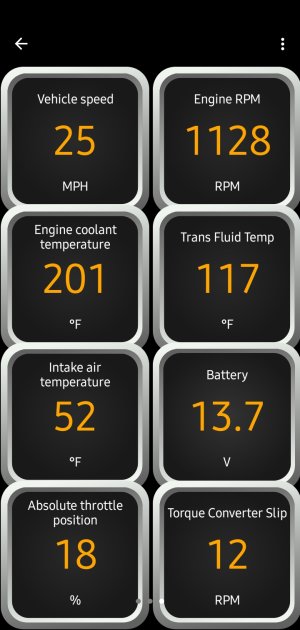
Inspired by @theterminator93 's response to @GRWeldon 's thread, I went ahead and added the Ford TC slip PID to my dashboard in OBD Fusion.


The Good

At steady cruising in 3rd or 4th over 40 mph, slip reads anywhere between 0 and 4 RPM, with rare spikes to 6 or 7 RPM. That sounds just about right.

At anything other than steady cruising, such as acceleration or driving in lower gears, slip fluctuates a lot, too much so to make exact sense of it, though it appears within an expected range (couple hundred RPM).


The Odd

Where the data falls apart is at a standstill. Logically, at 0 MPH, I would assume that TC slip should be = engine RPM. Wouldn't that make sense? Or am I missing something here?

Instead, the app shows TC slip at more than twice the engine RPM. Can anyone explain this? Or is it likely a programming mistake in the app?


I did take screen shots and can post them on request, but they really don't add any further intel.
 
...so I'm guessing nobody knows or cares. Granted I guess the main thing is that slip is 0 or close to 0 during TCC lockup, which is the case.

But the geek in me wants to understand the display values when it's  not locked up.
 
I don't have/use these types of apps - I still use the antiquated laptop + XCal2 datalogging method. 👴

My guess is there's some generic formula in the app that applies to the raw data from the bus which works for "most" applications but with our early OBD-II designs isn't quite the same. It might also be calculating the data using different data sources than the LiveLink PIDs which produces a different result, especially if one of the data sources used in the calculation is extrapolated data from other sources due to said data source not existing on our PCMs.

Without the duty cycle PID I agree that the most important takeaway is nominal levels of slip during cruise. The slip during acceleration seems high at first glance but may be commanded (again, no way to know without the duty cycle PID).
 
Sorry, I do not. I just use the built-in PIDs in LiveLink that the software detects are compatible with the strategy of the PCM it's connected to.
 
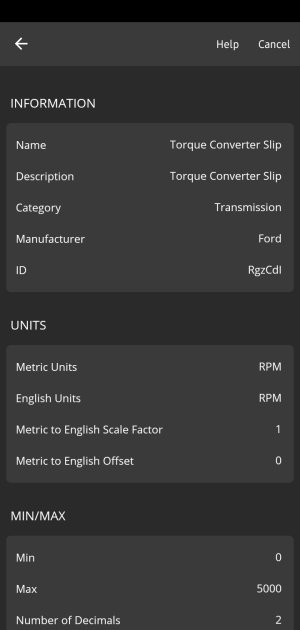
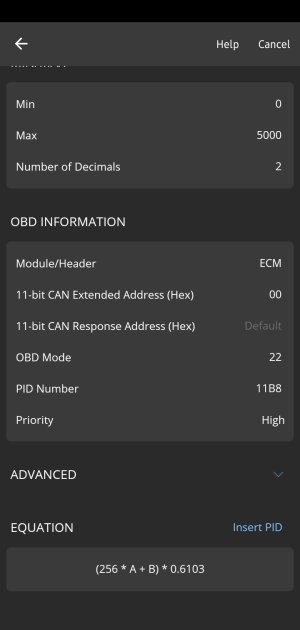
Right, but even for built-in PIDs, in my app I can go into properties, and it displays a formula plus various other things. Example below for torque converter slip:

Screenshot_20251031_153726.jpgScreenshot_20251031_153744.jpg
 
I'd recommend .finding a used xcal 2 and up, so you can use live link; even a locked one is fine, if you're not going to use it to program.
as slip is indicated by a difference in rpm, formula is irrelevant; If rpm climbs while vss is constant while tc is locked duty cycle=100%, you have a clutch slipping, which means it's spewing shit all thru the trans. = full rebuild and new tc.
Drop the pan and see.
 
Last edited:
I'd recommend .finding a used xcal 2 and up, so you can use live link; even a locked one is fine, if you're not going to use it to program.
as slip is indicated by a difference in rpm, formula is irrelevant; If rpm climbs while vss is constant while tc is locked duty cycle=100%, you have a clutch slipping, which means it's spewing shit all thru the trans. = full rebuild and new tc.
Drop the pan and see.

I understand that. I have no indication of such a concern. The RPM difference = TC slip seems to work fine in the app, and it indicates near zero in 4th with TC locked.

I will say the RPM difference varies more in 3rd gear. That's why I was curious what exactly the PCM is commanding in 3rd in terms of lock-up percentage.

This is just me being curious. I looked closely at my fluid during the cooler installation, and it was completely clean.
 
Update on this subject.

As you may remember, I'm using OBD Fusion to monitor, among other things, torque converter slip.

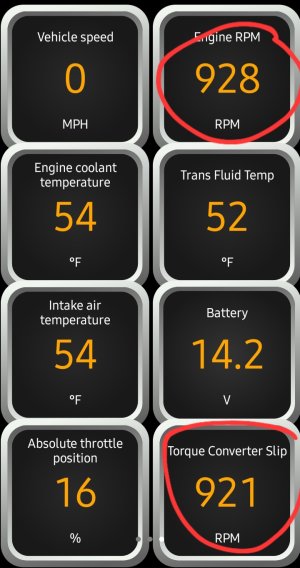
Up to now, when locked, data made sense (close to zero); but at idle at a standstill, data made no sense (should be equal to engine rpm, but was way higher).

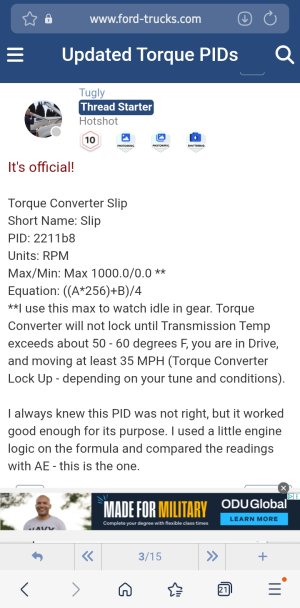
I came across this truck site today:

Screenshot_20260426_115104_Samsung Internet.jpg


After updating my formula accordingly, my readout at standstill does indeed (approximately) match engine rpm. Whatever small variance exists, I attribute to the values refreshing at different intervals.

Screenshot_20260426_112209.jpg


I like to know what's happening, so this is useful functionality to me.

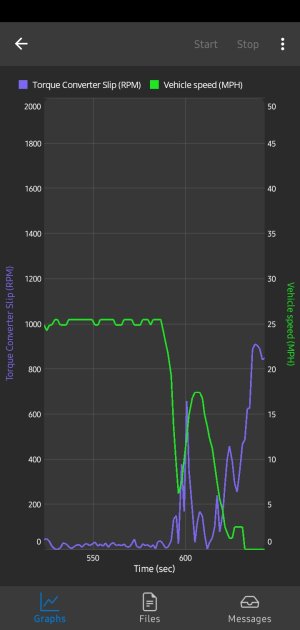
In 4th at highway speeds, lockup is essentially permanent. What I find more interesting is the behavior of "controlled slip" which is mostly prevalent in 3rd.

The screenshot below shows me driving through my neighborhood in 3rd; the screenshot below that shows the same drive followed by my final turn into my street, and then pulling into my driveway.

Screenshot_20260426_114445.jpg

Screenshot_20260426_120232.jpg


The behavior here at 25 mph, purple graph, shows slip fluctuating between zero and 40 rpm or so.

I have no reason to believe that this wasn't normal! Everything is smooth, and the behavior makes perfect sense for optimum fuel efficiency. I just don't particularly like it.

In these neighborhood street, I'd prefer if the torque converter simply remained unlocked. Incidentally, that would not increase slip by much, because throttle input and load are minimal; but it would eliminate the low-rpm lugging sensation when going uphill. Hence my question yesterday in the Unofficial Stupid...thread about a potential TCC disable.
 
The only other signal that affects tc lock, is EC coolerT. as long as the engine is below temp, the tc is unlocked.
I have had the tc unlock due to low engine temp. (stuck open thermostat, large trans
cooler, 22 below 0, 80mph)
I felt it unlock, slowed down, and it relocked in a mile.
 
The only other signal that affects tc lock, is EC coolerT. as long as the engine is below temp, the tc is unlocked.
I have had the tc unlock due to low engine temp. (stuck open thermostat, large trans
cooler, 22 below 0, 80mph)
I felt it unlock, slowed down, and it relocked in a mile.

Understood, but really not a factor here in Virginia. It reaches temperature to lock up within the first mile of driving 11 months out of the year.
 

Similar threads

Back
Top