Cooler Installation Kit? NOW WITH POLL.

Best Transmission Cooler Setup?

  • Cooler in radiator (stock)

    Votes: 1 5.0%
  • Added cooler without bypass thermostat (OEM TSB setup); transmission > radiator > cooler > transm.

    Votes: 7 35.0%
  • Added cooler with bypass thermostat; transmission > radiator > cooler > transmission

    Votes: 0 0.0%
  • Cooler only, without bypass thermostat; transmission > cooler > transmission

    Votes: 11 55.0%
  • Cooler only, with bypass thermostat; transmission > cooler > transmission

    Votes: 1 5.0%

  • Total voters
    20
On my red cougar, I followed the factory route. The fittings into the trans are bpst, British pipe straight thread. an npt will go, but it rethreads the case.
 
Last edited:
What happens when you use an 11/32 hose over 5/16 tubing, even with double clamping...

With the lower (= transmission to cooler) hose as wet as this, I initially thought the upper hose was leaking and dripping onto the lower hose. But the upper hose is entirely dry. The lower hose appears to be leaking, and somehow the fluid "migrates" all around the hose, defying gravity?

I ran the engine for a few minutes while monitoring, and while I could feel some very light wetness, there was no visible dripping. It must be a very slow leak. There is a small stain on the plastic underbody shield below.

I didn't address the issue because I discovered it in the afternoon and wouldn't have enough daylight time left. ATF level was normal for the cold temperature. I figured it doesn't require immediate attention.

The fact that it happens only on the hose to the cooler does worry me a bit regarding the pressure/resistance this cooler might add to the system. That's why I initially favored a tube style cooler. This stacked-plate style cooler does present more of an obstacle to fluid flow; on the other hand, at 11"×11" this cooler is pretty large, which should help fluid flow (?).
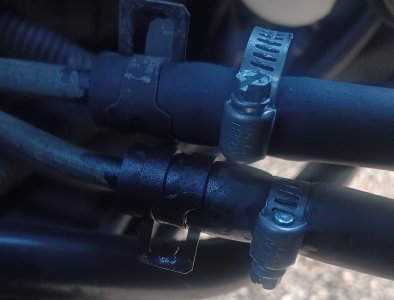

20251201_142356.jpg
 
The area thruthe plates is way bigger than a tube,morethan 10x. You have a leak on the pressure side you need a better connection. A compression fit barbed connector would work.
 
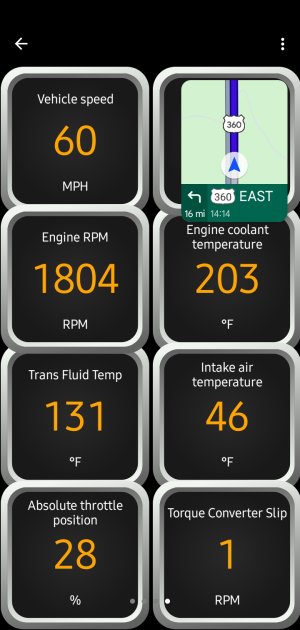
More transmission cooler testimonial, this time in higher ambient temperatures, approximately 100 miles one way, speed limit varying between 60 and 70 mph.

Outbound, ambient temperatures in the 80s; transmission maxed out at 163°F.

Screenshot_20260517_110144.jpg


Return, ambient temperatures in the 90s; transmission maxed out at 166°F (though these screen shots show 165°F; it was fluctuating):

Screenshot_20260517_135310.jpg

Screenshot_20260517_135321.jpg


Transmission temperatures drop as soon as I leave the freeway. This is right after pulling into my driveway:

Screenshot_20260517_144628.jpg


I post these really to encourage others to install a cooler if you haven't done so. These temperatures are solidly 40°F below what I used to see in hot weather (which was essentially transmission temperature = engine temperature). This is with fresh fluid if it matters.

Speaking of engine temperature, it's firmly at 210°F during freeway cruising, which...sounds high? Coolant is fresh, too.

And since viscosity was a topic in my Maxlife thread, Maxlife viscosity at 165°F is equivalent to Mercon V viscosity at 183°F.
 
All transmission fluids are~ 5wt, mineral oil, with modifiers, and seal swellers. Those last two cause the types.
 
Transmission fluid types; it's all friction modifiers, additives, all added to a thin oil. Trans fluid's primary task is to move heat.
 

Similar threads

Back
Top